
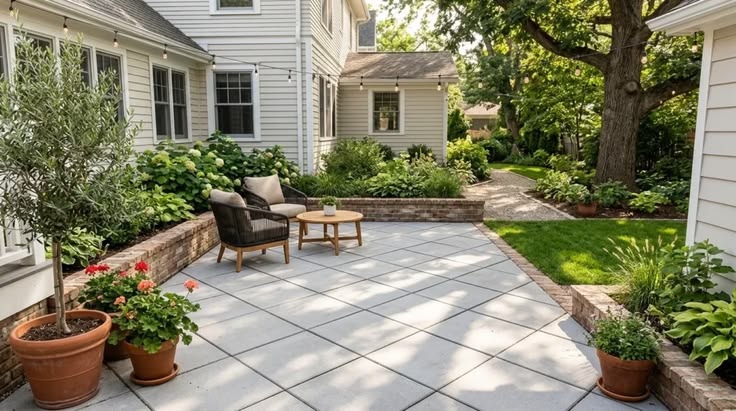
Fall is one of the best times to install a paver patio in Wayne, PA. Cooler weather helps crews compact the base properly, soil is stable, and contractors have more open schedules. Pavers can be installed until the ground freezes, which in the Wayne area is often late November or December, depending on the year. Interlocking pavers outperform poured concrete in Pennsylvania’s freeze-thaw climate because they flex with ground movement and can be repaired one unit at a time. A durable patio depends mostly on a compacted stone base and drainage sloped at about 2 percent.
Is Fall a Good Time to Install a Paver Patio in Wayne, PA?
Yes. Cooler temperatures make base compaction easier, the soil is usually drier than in spring, and contractors have more room in their schedules. Booking before the first snowfall puts you in line for a patio that’s ready by spring.
If you’ve been picturing a patio for outdoor dinners, a fire pit, or a cleaner entryway, the weeks before winter sets in are a good time to get started. Below, we answer the questions homeowners ask most about patio installation, choosing a paver contractor, and timing a project in Wayne and across the Main Line.
Why Is Fall the Best Time for Patio Installation?
Does Cooler Weather Help a Paver Patio Installation?
It does. A paver patio is only as strong as the base beneath it, and that base is built by compacting layers of aggregate with heavy equipment. Crews work faster and more consistently in 50- to 70-degree weather than in July heat, and the soil is rarely saturated the way it can be during the early spring thaw.
Do You Get Better Contractor Availability in Fall?
Usually, yes. Spring is the busiest season for any paver contractor, with lead times stretching for weeks or months. Fall projects booked now can often start sooner and finish before the holidays. Homeowners who sign a contract in the fall also tend to be first in line when the spring schedule fills up.
Can Pavers Be Installed Right up to the First Freeze?
Pavers can be installed as long as the ground is workable. The critical requirement is that the base material is not frozen when it is placed and compacted. That’s the real reason to book before the first snowfall: once the ground freezes, quality base preparation becomes difficult or impossible, and reputable contractors will pause work.
Does a Fall Installation Let the Patio Settle Before Spring?
A properly built patio doesn’t need to “settle,” but a fall installation gives the base and joint sand a full winter to lock in under real conditions, so your patio is ready for heavy use by spring.
What Is the Difference Between a Paver Patio and a Concrete Patio?
This is one of the most common questions in patio installation, and it matters in Pennsylvania, where freeze-thaw cycles are hard on rigid surfaces. A concrete slab is a single piece. When the ground moves, it cracks. Pavers are individual units on a flexible base, so they move slightly together and can be repaired by lifting out a few stones rather than breaking out a slab.
What Factors Change the Price of a Patio Installation?
● Paver type: Concrete pavers cost less than natural stone or porcelain.
● Site conditions: Slopes, tight access, and poor soil add excavation and drainage work.
● Base depth: Heavier-use areas such as driveways require a thicker base than patios.
● Add-ons: Seat walls, steps, fire pits, lighting, and outdoor kitchens.
● Pattern complexity: Curves, borders, and inlays take more cutting and labor.
The best way to compare quotes is to request itemized estimates that specify excavation depth, base material, and edge restraint, not just a total number.
How Are Paver Patios Installed? (Step-by-Step)
A professional paver contractor follows a repeatable sequence. Skipping or rushing any step is the leading cause of sinking, shifting, and weeds.
- Design and layout. Measure the space, confirm property lines and utilities, choose materials and patterns, and mark the footprint. In Pennsylvania, contact PA811 at least three business days before any digging so buried utilities are marked.
- Excavation. Remove sod and soil to the required depth, generally enough for a compacted base plus bedding layer plus paver thickness.
- Grade and slope. Shape the subgrade so water drains away from your home. A common industry guideline is a minimum slope of about 2 percent, roughly a quarter inch per foot.
- Compact the subgrade. Run a plate compactor over the native soil to create a stable, uniform foundation. Soft spots are removed and replaced.
- Install geotextile fabric where needed. In clay-heavy or unstable soils, fabric separates the base from the soil below and prevents migration of fines.
- Place and compact the aggregate base. Add crushed stone in thin layers, called lifts, and compact each one. This base provides the strength; for a typical residential patio, industry guidance commonly calls for roughly 4 to 6 inches, and more for vehicle loads or weaker soils.
- Screed the bedding layer. Spread about one inch of bedding sand or fine stone and screed it perfectly flat. The bedding layer is not meant to be thick or structural.
- Lay the pavers. Set units in the chosen pattern, working from a fixed starting point and checking lines often. Cut edges and curves with a wet saw.
- Install edge restraints. Rigid edging locks the perimeter in place so the pavers cannot spread outward.
- Compact and fill the joints. Run the plate compactor over the pavers, sweep in polymeric or joint sand, compact again, and sweep clean.
- Seal if desired. Sealing enhances color and helps resist stains, but it should be done only after the manufacturer’s recommended cure time.
How Long Does It Take to Install a Paver Patio?
Most residential patios of 200 to 400 square feet take roughly 3 to 7 working days, weather permitting. Larger patios, multi-level designs, and projects with walls, steps, or drainage work take longer. Because fall days are shorter and weather windows narrower, scheduling early in the season keeps your project ahead of December weather.
Why Do Paver Patios Last Longer in Pennsylvania Winters?
How Do Freeze-Thaw Cycles Affect Patios?
Southeastern Pennsylvania regularly swings above and below freezing through winter. Water that enters the ground or a hairline crack expands as it freezes, then contracts when it thaws, repeating again and again. Rigid surfaces fail along those stress points. A well-built paver system is designed to drain, flex, and recover.
Why Does Base Preparation Matter More Than the Paver Itself?
What you see on the surface is the smallest part of the job. Most patio failures trace back to an under-built base, poor compaction, or inadequate drainage, not to the stone on top. When comparing paver contractors, ask more questions about what’s underneath than what’s on top.
How Do You Maintain a Paver Patio Through Winter?
● Keep surfaces clear using a plastic shovel rather than a metal blade, which can chip edges.
● Use calcium magnesium acetate or sand for traction instead of rock salt where possible, since de-icing salts can damage some pavers and sealers over time.
● Avoid sealing in cold weather; sealers need temperatures in the manufacturer’s recommended range to cure.
● Refresh joint sand in spring if you see gaps or weeds.
Should You Book Your Paver Patio Before Winter?
If you want a patio ready for the first warm weekend of spring, yes. Booking in fall secures your design, locks in a build window, and can place you ahead of the spring rush. If the ground freezes before your project can start, you can still finalize the design, materials, and permits over the winter and be first on the schedule in March or April.
Ready to plan? Contact Greenstone Gardens to schedule a site visit and request an itemized patio installation estimate for your Wayne, PA property.
Frequently Asked Questions About Patio Installation and Paver Contractors
1. How long do paver patios last?
A properly installed paver patio can last 25 to 50 years or more. Longevity depends mostly on base preparation, drainage, edge restraint, and routine maintenance such as refreshing joint sand.
2. Is a paver patio better than concrete?
For Pennsylvania’s freeze-thaw climate, usually yes. Pavers flex with ground movement and can be repaired by replacing individual units, while concrete tends to crack and is hard to patch without the repair showing. Concrete does have a lower upfront cost.
3. Can you install pavers in the fall?
Yes. Fall is an ideal season, as long as the ground is not frozen. Cooler temperatures help crews compact the base well, and you get a patio ready for spring.
4. How deep should the base be for a paver patio?
For a typical residential patio, industry guidance commonly calls for about 4 to 6 inches of compacted aggregate base plus roughly 1 inch of bedding sand. Soft soils or driveway loads require a deeper base.
5. Do paver patios need a permit in Wayne, PA?
It depends. Many municipalities regulate impervious coverage, grading, or structures such as walls and fire pits. Check with Radnor Township or your local building office before construction, and ask your contractor to confirm requirements.
6. Do pavers need to be sealed?
No, sealing is optional. It can deepen color, resist stains, and stabilize joint sand, but it must be reapplied every few years. Always follow the paver manufacturer’s guidance on timing.
7. Why do paver patios sink?
Sinking is almost always caused by an inadequate or poorly compacted base, poor drainage, or soil that was not stabilized. Fixing it means lifting the pavers, rebuilding the base, and relaying the stones.
8. How do I find a reliable paver contractor near me?
Look for local project photos, verified reviews, written scope details, a Pennsylvania HIC registration number, proof of insurance, and a clear warranty. Ask how they prepare the base, handle drainage, and compact each layer.
9. How soon should I book a patio installation before winter?
As early as possible. Contractors schedule on a first-come basis, and the workable window closes once the ground freezes. Booking now secures either a fall build or a priority spot at the start of spring